Wednesday, 7 January 2015

Tuesday, 6 January 2015
50 years of B lymphocytes and why it matters for Melanoma
Immunology: Fifty years of B lymphocytes
http://www.nature.com/news/immunology-fifty-years-of-b-lymphocytes-1.16653
In 2013, Cancer Immunotherapy was chosen as the breakthrough- therapy of the year 2013 by the scientific journal Science, a choice Melanoma patients can relate to very well- as it is novel anti-based therapies blocking brakes in the bodies own immune system- like CTL4, PD1 or PDL1 antibodies- that for the first time ever provide substantial hope of long-term survival in Melanoma.
The article in Nature at the occasion of the 50th anniversary of the publication of the paper that first described two classes of lymphocytes- without this knowledge, we wouldn't have today's greatest hopes in Melanoma.
From the article-
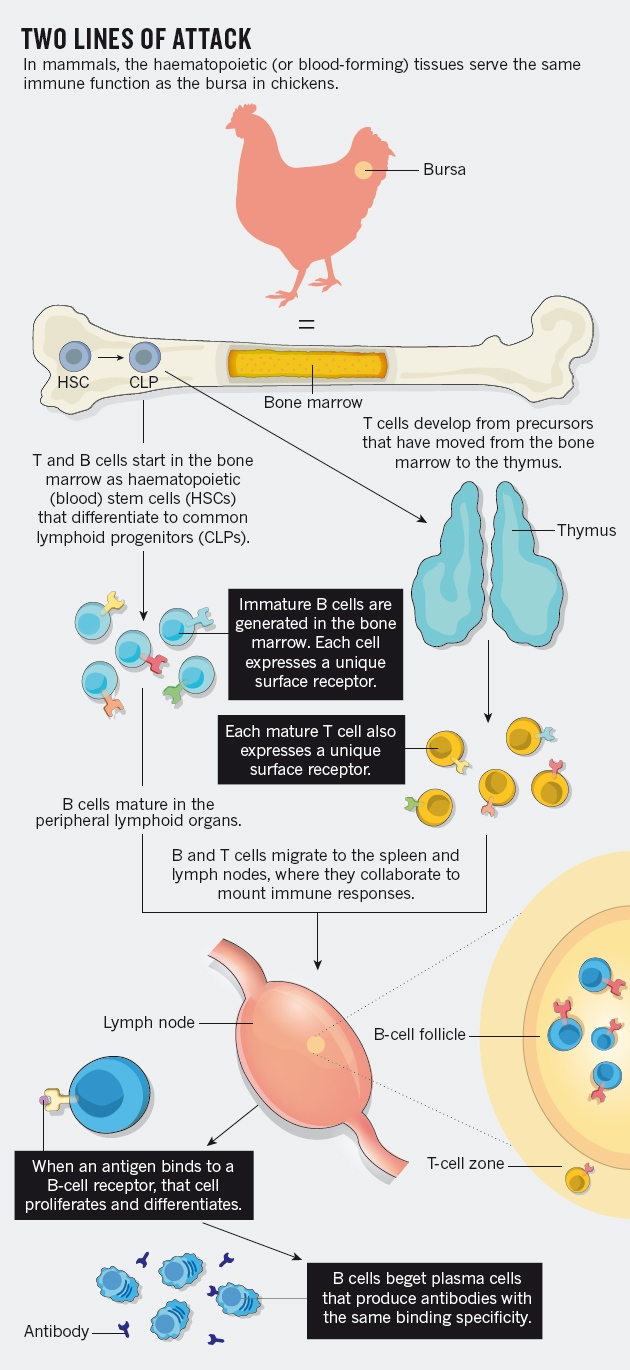 'At the time, the central question in immunology was how vertebrates tailor their defences to bacteria and viruses, whose chemical structures show nearly unlimited diversity. Within two years of joining Good's laboratory, Cooper had made a discovery about the cells that accomplish this task — lymphocytes — that proved essential to cracking the mystery, and ultimately to unifying the camps of his field.
Fifty years ago this week, Good, Cooper and their colleague Raymond Peterson published a paper1 in this journal revealing that there are two types of lymphocyte. The insight shaped the course of modern immunology and influenced the study and care of immunodeficiency conditions, cancers of the immune system and the development of monoclonal antibodies — powerful research tools and therapeutics.
…. read further here
p.s. considering the amount of tax-funded research that went into these discoveries over now more than 50 years, maybe society should be getting a better ROI in form of affordable drugs?
Saturday, 27 September 2014
Banning patient advocates from parts of congresses is unconstructive and anachronistic.
The ultimate purpose of medicine is to serve patients.
Only
patients can tell us whether a treatment meets their expectations. In these
exciting times, where break-through discoveries meet financial austerity,
ignoring patients’ demands is a waste of resources that we as civil society
should not tolerate.
Patient advocates are de facto health care professionals,
providing patients with support, advice and information. It is therefore in all
our interest that advocates have access to reliable, validated information
sources and are as educated as possible to
1. best serve patients and
2.
contribute the patient perspective in a maximally constructive way, so that we
are reaching our goal- meaningful medicine for all patients.
The current situation at the ESMO 2014 congress where
advocates are banned from certain areas of the conference is therefore both
unconstructive and anachronistic. The very same advocates meant to require
protection from the- highly regulated and checked for scientific and legal
accuracy- promotional material for new drugs have already discussed the
clinical trial protocols and set on the advisory boards when these very drugs
underwent development.
Patient advocates attending scientific congress are highly
motivated individuals who dedicate enormous amounts of their time- often
unpaid- to educate themselves in order to help others. We as society ignore
that expertise at our own peril.
Today, it is opportune for everyone in health to claim to have 'the patient at the centre' of all endeavours. For all of us as society to profit from the existing patient knowledge to build a better future, not only for today's but also for future patient generations, will require more than lip service.
Bettina Ryll
Founder Melanoma Patient Network Europe

Tuesday, 22 July 2014
MPNE Workshop Nov 2014- project management for European Melanoma advocates
Registration for the MPNE Workshop Nov 2014
'project management for European Melanoma advocates' is open!
 In addition, there will be plenty of opportunity to meet Melanoma advocates from other European countries for you to share your experiences and to get inspired by what others have been doing.
Read more and register via the MPNE website- looking forward to meeting you at Krusenberg Herrgård in Sweden!
'project management for European Melanoma advocates' is open!
Why a project management workshop?
Most Melanoma advocates are highly- motivated volunteers who use their spare time for advocacy, in addition to their profession, their family life and sometimes while being patients themselves.
We all want to see the desperate situation of today's Melanoma patients change and managing advocacy projects with limited resources of time and money successfully is one of the key factors to ensure progress- therefore this workshop!
In addition, there will be plenty of opportunity to meet Melanoma advocates from other European countries for you to share your experiences and to get inspired by what others have been doing.Read more and register via the MPNE website- looking forward to meeting you at Krusenberg Herrgård in Sweden!
Monday, 21 July 2014
Sunday, 6 July 2014
GSK MEK inhibitor authorised in Europe!
The GSK MEK inhibitor (also Trametinib, now called Mekinist ® has been approved in Europe- http://goo.gl/xoZwrN
So now we are waiting for the up-date of the BRAF/MEK combination versus BRAF mono therapy! The latest results as presented at ASCO surprisingly looked like that the GSK BRAF monotherapy (Dabrafenib) was actually better than initially assumed- much more in the league of the Novartis BRAF inhibitor which makes for quite some interesting thoughts in the light of the currently ongoing Novartis/ GSK deal, especially as Dabrafenib was priced at a *lower price* than Vemurafenib in the US- so who knows we might actually see the day where we get better drugs for lower prices, very much in line with the recognition of the Novartis CEO Jimenez that the endless stacking of expensive cancer therapies is not sustainable as published this April in Forbes.
These latest results are at odds with previous results that had shown that the BRAF/ MEK combo resulted in longer time to resistance and fewer side effects, in particular less joint pain, rash and new skin cancers forming than either mono therapy with a BRAF or a MEK inhibitor.
Because the REAL question is obviously going to be- who is going to pay for a drug that in mono-therapy is not as good as a BRAF inhibitor?
Friday, 13 June 2014
Benefit/risk assessment in patients- really good webinar!
This was a really good webinar organised by EMA, EFPIA and CASMI
http://vitaltransformation.com/2014/05/webinar-the-patients-understanding-of-benefit-risk/
The cancer community can learn a lot from the experience of the rare disease groups!
Subscribe to:
Posts (Atom)